Beta HCG Levels After IVF Transfer: What Your Numbers Mean

Table of Contents
Written for Pharmacyexprezz & Pivate Clinic: Reviewed by Waheedat Owodeyi. Superintedent Pharmacist. General Pharmaceutical Council Registraion Number 2065550..
The two-week wait after an embryo transfer is incredibly tough. It all builds up to “official test day.” On this day, your clinic performs a quantitative blood test to measure your Beta HCG levels after IVF transfer.
Unlike a home urine test that simply gives a “yes” or “no” answer, this blood test provides a specific number. This exact value gives your medical team vital clues about how well your embryo is growing.
At Pharmacyexprezz, we know how overwhelming this waiting period can be. Breaking down these numbers into simple facts can help you understand what your clinic is looking for.
What is a Beta HCG Test?
Human Chorionic Gonadotropin (HCG) is a pregnancy hormone. It is made by cells that eventually develop into the placenta.
Measuring Beta HCG levels after IVF transfer is highly structured:
- Precise Timing: Your clinic knows the exact hour your embryo was transferred.
- Embryo Age: They know whether it was a Day 3 or a Day 5 embryo.
- The Window: Because of this exact timeline, they can pick the perfect day for your blood test—usually between 9 and 14 days after the transfer.
- Accuracy: Testing during this specific window prevents false results caused by lingering fertility trigger shots.
Reading Your First Beta HCG Numbers
When your fertility nurse calls with your results, remember that “normal” looks different for everyone.
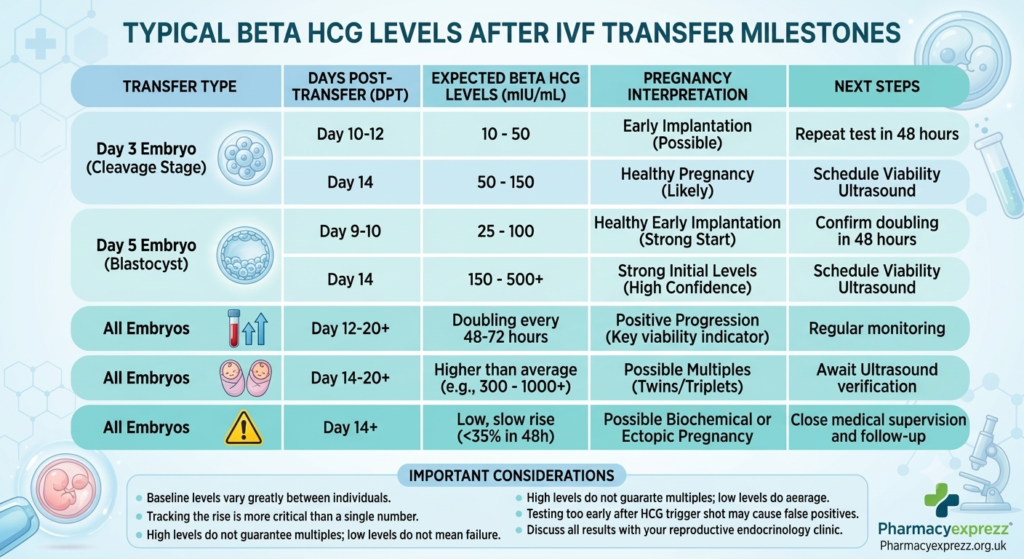
- Above 5 mIU/mL: This is generally considered a positive result, showing that implantation has occurred.
- 50 to 100 mIU/mL: This is the baseline range most clinics like to see by Day 14 for a strong, confident start.
- Under 5 mIU/mL: This is usually considered a negative result, meaning implantation did not take place.
What Is Your Medical Team Tracking?
Your clinic is not just looking at a single number. They are evaluating several key factors:
- The 48-Hour Doubling Time: The initial number matters less than how fast it rises. In a healthy early pregnancy, HCG levels should double every 48 to 72 hours.
- Signs of Multiples: Very high initial Beta HCG levels after IVF transfer can sometimes mean more than one embryo attached, resulting in twins or triplets.
- Potential Risks: Low numbers that rise very slowly or drop can signal a biochemical pregnancy (an early miscarriage) or an ectopic pregnancy.
Frequently Asked Questions About IVF Beta Results
To help you better navigate your lab report, here are quick answers to what patients ask most:
- Can a baseline number start low and still result in a healthy baby? Yes. Many successful pregnancies start with a low initial baseline, as long as your Beta HCG levels after IVF transfer double properly over the next few days.
- Why do some clinics test on Day 9 and others on Day 14? It depends on your embryo’s development stage. Checking Beta HCG levels after IVF transfer can happen earlier (around Day 9 or 10) for a Day 5 blastocyst because it implants sooner than a Day 3 embryo.
- What can cause a false positive HCG test? The most common cause is checking your blood work too early. A fertility trigger shot (like Ovitrelle or Novarel) contains HCG, which can linger in your system and temporarily inflate your Beta HCG levels after IVF transfer.
- What happens if my numbers are fluctuating? Fluctuating, stalling, or low rising Beta HCG levels after IVF transfer usually mean the pregnancy is unstable. This scenario requires your doctor to order close medical supervision and extra blood work to rule out a biochemical or ectopic pregnancy.
What Are the Next Clinical Steps?
Because tracking the rise is so important, your clinic will almost always schedule a repeat blood test two days after your first one.
- Step 1: First blood draw to establish your baseline number.
- Step 2: Second blood draw 48 hours later to check the doubling rate.
- Step 3: A viability ultrasound scan, usually booked around week 6 or 7, once numbers rise safely.
Supporting Your IVF Journey
An active IVF cycle requires a strict medication schedule. Keeping track of everything should not add to the stress of your two-week wait.
At Pharmacyexprezz, we specialize in providing reliable, discreet pharmacy services for fertility patients. We make sure your progesterone supports, injections, and prenatal supplements arrive safely and exactly when you need them.
beta hcg after ivf, beta hcg levels, ivf blood test, ivf pregnancy test, pharmacyexprezz, pregnancy hormone test, quantitative hcg